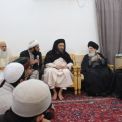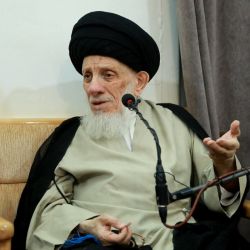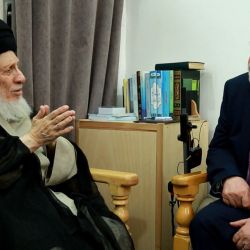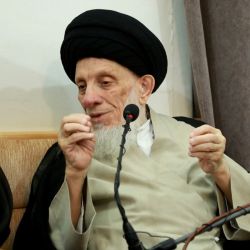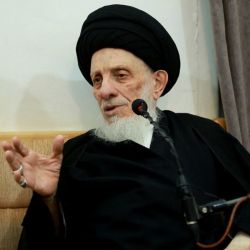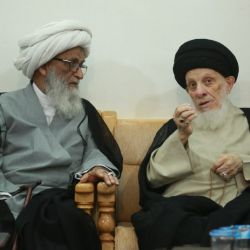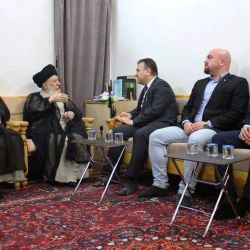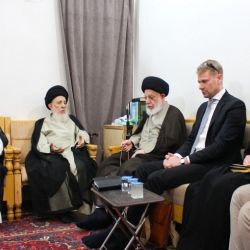
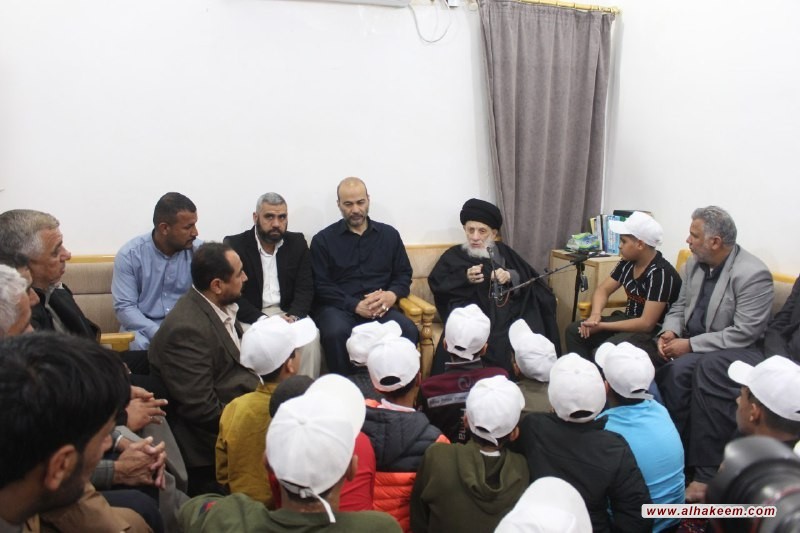
His Eminence Al-Sayyid Al-Hakeem meets a group of orphaned children of the martyrs of the Popular Mobilization Forces

His Eminence Al-Sayyid Al-Hakeem meets a group of orphaned children of the martyrs of the Popular Mobilization Forces
2020/02/20

His Eminence Grand Ayatollah Sayyid Mohammed Saeed Al-Hakeem, on 16 February 2020, received a group of youth from Baghdad, children of martyrs who died fighting in the Popular Mobilization Forces (Al-Hashd Al-Sha’bi) against Daesh.

His Eminence praised the clear and manifest courage of their fathers and their sacrifice for their religion, their homeland and the holy shrines. By the grace of Allah and through their sacrifice and spilling of their noble blood, they were victorious over the enemies.

His Eminence called them to follow the Holy Prophet and the Imams of the Ahl al-Bayt (peace be upon them all), and that their ethics and morals should by distinctly higher than others, and that they should adhere to the teachings of the Sharia.

His Eminence concluded by praying to the Most High and Mighty to provide support for them and to support those who serve and help the orphans, that their Ziyarah is accepted, and that they see the blessings of it in this life and the Hereafter. He finally requested that his greetings and best wishes be conveyed to their families.
Day Questions

According to the edict that I have read, khums is obligatory on coined gold which remains unused for a year. Is khums also obligatory on gold bars? If so, will khums become payable on the annual khums date or after a year from the date of purchase of the gold bar?

It is obligatory on every individual to pay the fifth of his/her net profit that remains at the end of the khums year, whether these profits were silver or gold coins, or in the form of bars, and whether the profits were real estates or other kind of assets.

Is it allowed to recite Surah Al-Jumu’ah or any other surah aloud during Dhuhr prayer on the day of Friday?

Yes, it is permissible, rather it is recommended to recite it an audible voice.

According to Shia Islamic law, does the woman have the right to divorce herself from her husband?

No, she does not have this right. However, if the wife stipulates a condition in the marriage contract that she will be his agent in her own divorce in such a way that she cannot be discharged from such an appointment and the husband agreed to this, then she can divorce herself on behalf of her husband. She can also divorce herself on behalf of her husband, if she makes it a condition in the marriage contract that if the husband travels and disappears during his travel, she will be his agent in reciting the divorce formula.