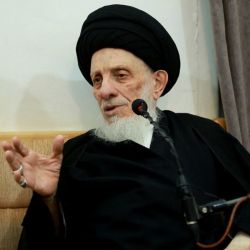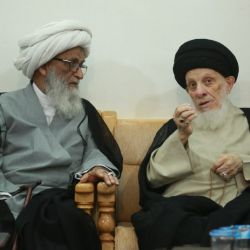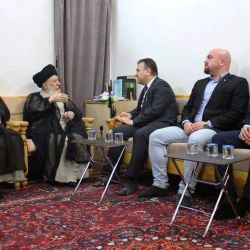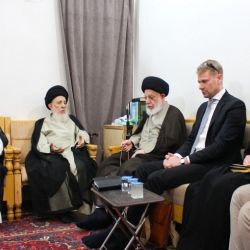
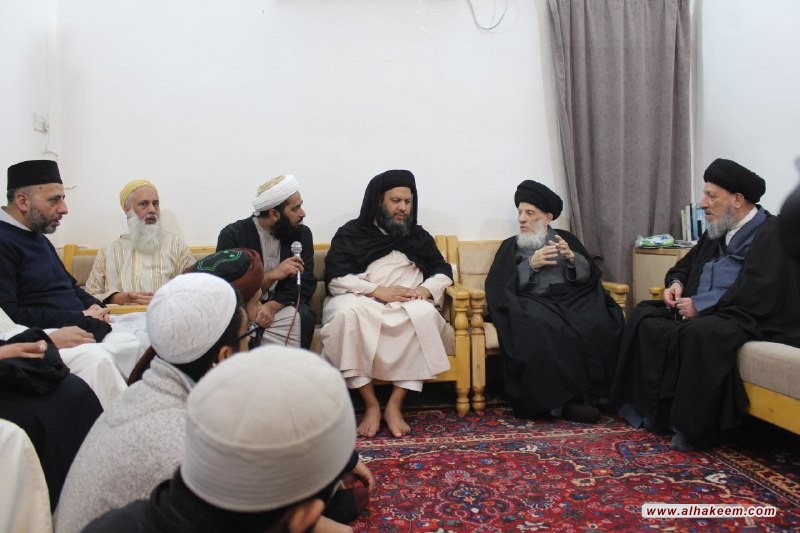
Grand Ayatollah Sayyid Al-Hakeem receives a Sufi group from the UK

Grand Ayatollah Sayyid Al-Hakeem receives a Sufi group from the UK
2020/01/03

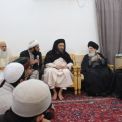
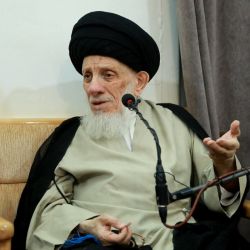
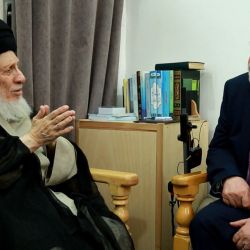
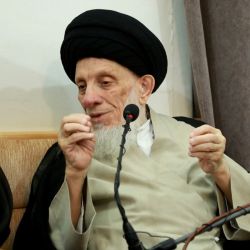
Grand Ayatollah Sayyid Mohammed Saeed Al-Hakeem received a Sufi group from the UK on Thursday, 2nd January 2020. He advised that the Muslims in all nations across the world to increase the dialogue, cooperation and affection amongst each other. He emphasized the importance of unity, through entrenching the commonalities and strengthening them.

His Eminence narrated to his guests the narration of the Holy Prophet (peace be upon him and his progeny): “Compassion has not been placed in something, but that it adorns it; and foolishness has not been placed in anything, but that it causes it disgrace.”

His Eminence called all Muslims to act upon the straight path shown by the Holy Quran and the teachings of the Prophet (peace be upon him and his progeny), with beautiful ethics, taking the Prophet as an example in how he was able to establish his personality amongst the polytheists, with his beautiful etiquettes and ethics.
Day Questions

There are two traditions that I have come across, and I would like to know which books they can be found in, and which of the Sunni books have reported them: 1. Innal Husayn Misbahul Huda wa Safinatun Najaa 2. Al-Husayn Minniy wa Ana Minal Husayn.

The first narration is narrated in the book al-Maqtal authored by Al-Turayhi who narrated it from Ubay bin Kaab. The content of the said narration, i.e. that Hussein is a light of guidance to the truth and whoever follows him will be saved from misguidance, is one of those concepts that is found in many narrations about the Ahlulbait, like the tradition of al-Thaqalain and the tradition of al-Safeenah and others. The second tradition is narrated in many Sunni and Shia sources of narrations; Ahmad bin Hanbal mentioned it in his Musnad (vol. 4, p. 174), as well as al-Tirmidhi (vol. 5, p. 324), Mustadrak al-Hakim (vol. 3, p. 177), and many more.

Why do the Shia make the five prayer times into three prayer times, by praying Dhuhr and Asr together, and Maghrib and Isha together?

Shias did not make this up. The Prophet (peace be upon him and his holy progeny) joined between the Dhuhr and Asr prayers, and between Maghrib and Isha prayers when he was not traveling and when it was not raining – i.e. without an excuse and not during special circumstances – as per the texts narrated in famous Sunni hadith books.

What do you think about tableegh work - religious propagation, should it not be done by all people?

Teaching religious knowledge to the family is obligatory on every Muslim. It is also obligatory to teach devotees that it is expected to teach them. Also, it is obligatory to propagate the religion when religious knowledge is in danger.

I have temporarily married a woman from the Sunni school of thought, and I explained the marriage to her, she accepted the period of time and the dowry, she said her part and I accepted. Is this contract valid?  

If she intended to enter the marriage contract and agreed to the terms. then the marriage is correct and valid, even though her own sect would not agree with this.